
The superlatives assigned to Sir David Attenborough seem never to stop. Producer of the most watched nature documentaries in the world. The most traveled person in the world. The oldest person to visit the North Pole. The most trustworthy person in Britain.
My own close brush with his presence was on a visit to the Cambridge Conservation Initiative in 2016. Their newly remodeled home was named the Attenborough Building in his honor, and it featured a soaring four-story living wall in its atrium. Attenborough, then just turned 90, appeared at the opening ceremony. But he entered not on a red carpet, but like we would expect David Attenborough to do—he rappelled down the wall from the top, landing with nonchalant grace, as though it were the only reasonable option.
David Attenborough was born on May 8, 1926, in a London suburb and he grew up in the English midlands town of Leicester. He was always interested in nature, collecting bird eggs and fossils from a young age. He studied natural sciences at Cambridge before serving in the Royal Navy. But he never worked as a scientist, instead enticed into the world of writing and broadcasting.
He was particularly attracted by the new world of television. In 1950, he began training with the BBC and soon became a television producer. Being on the air seemed unlikely, because his teeth were considered too big! He overcame that obstacle quickly, however, his charm, demeanor and gift for commentary trumping any dental deficits. He hosted a quiz show (Animal, Vegetable, Mineral?) and another that brought animals into the studio.
Attenborough thought the studio format was limiting and stressful to the animals, and convinced the executives to let him produce a series filmed in the wild, Zoo Quest. And the rest, as they say, is history. The success of that show led to his assignment to lead a natural history group at the BBC and later, in 1965, to direct programming for the BBC (of note, Attenborough had the foresight to add a strange new comedy to their line-up; it was called Monty Python’s Flying Circus!).
He left the BBC in the early 1970s to produce independent nature documentaries. He hit it big in 1976, when his 96-episode masterpiece, Life on Earth, hit the airwaves. That series, watched by an estimated 500 million people, made Attenborough a household name around the world. Whether crawling into a termite nest or dropping into a cave, nothing was out of bounds for David Attenborough.
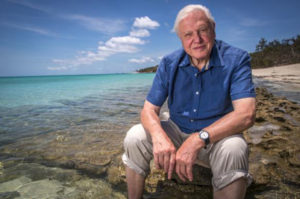
He is one of the world’s great storytellers, but he insists that nature is the real story. He has said, “…we mustn’t get the narrator in between the animal and the viewer too often.” Less is more when it comes to natural history. “If you can use four words intstead of five that’s good, and cut out every adjective you want to put in. People can see if it’s beautiful. You mustn’t be scared of silence.”
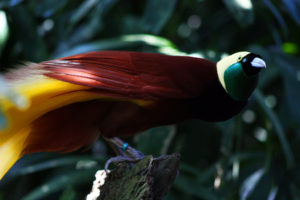
All of nature is his subject, but he always retained his intense love of birds. “I have been besotted with them since I was a schoolboy,” he said of his favorite bird, the Bird of Paradise, “when I read the travels of the great 19th Century British naturalists, the first Europeans to see these things. These birds are so romantic and they all have legends surrounding them. They all do the most extraordinary things, each with its individual dance and display.” His 10-episode series, The Life of Birds, in the late 1990s, was another masterpiece.
His list of awards is about as long as his list of nature documentaries. He was made a knight in 1985 and has more than 30 honorary degrees. In a 2014 poll, he topped the list of England’s most trustworthy public individuals.
His life observing and filming nature has also made him an avowed conservationist. A recent documentary series is about the relation between nature, humans and the built environment. He said of the London region, “Looking down on this great metropolis, the ingenuity with which we continue to reshape our planet is very striking. It’s also sobering. It reminds me of just how easy it is for us to lose our connection with the natural world. Yet it is on this connection that the future of both humanity and the natural world will depend.” He has become most worried about climate change and especially the role of the U.S.: “One doesn’t want to interfere with other nation’s affairs, but the trouble is nations of that size are globally important and what they do has a huge impact on us.”
He is now 92 years old, and he shows no sign of slowing down. He got a new pair of knees a few years ago, that he say gave him “another 20 years of life.” Thank goodness, because we can all use another 20 years of David Attenborough, rappelling down whatever wall he chooses.
References:
Biography.com. David Attenborough. Available at: https://www.biography.com/people/david-attenborough. Accessed May 4, 2018.
Davies, Gareth Huw. Meet Sir David. PBS. Available at: http://www.pbs.org/lifeofbirds/sirdavid/index.html. Accessed May 4, 2018.
Shute, Joe. 2016. David Attenborough at 90: ‘I think about my mortality every day.’ The Telegraph, 29 October 2016. Available at: https://www.telegraph.co.uk/men/thinking-man/david-attenborough-at-90-i-think-about-my-mortality-every-day/. Accessed May 4, 2018